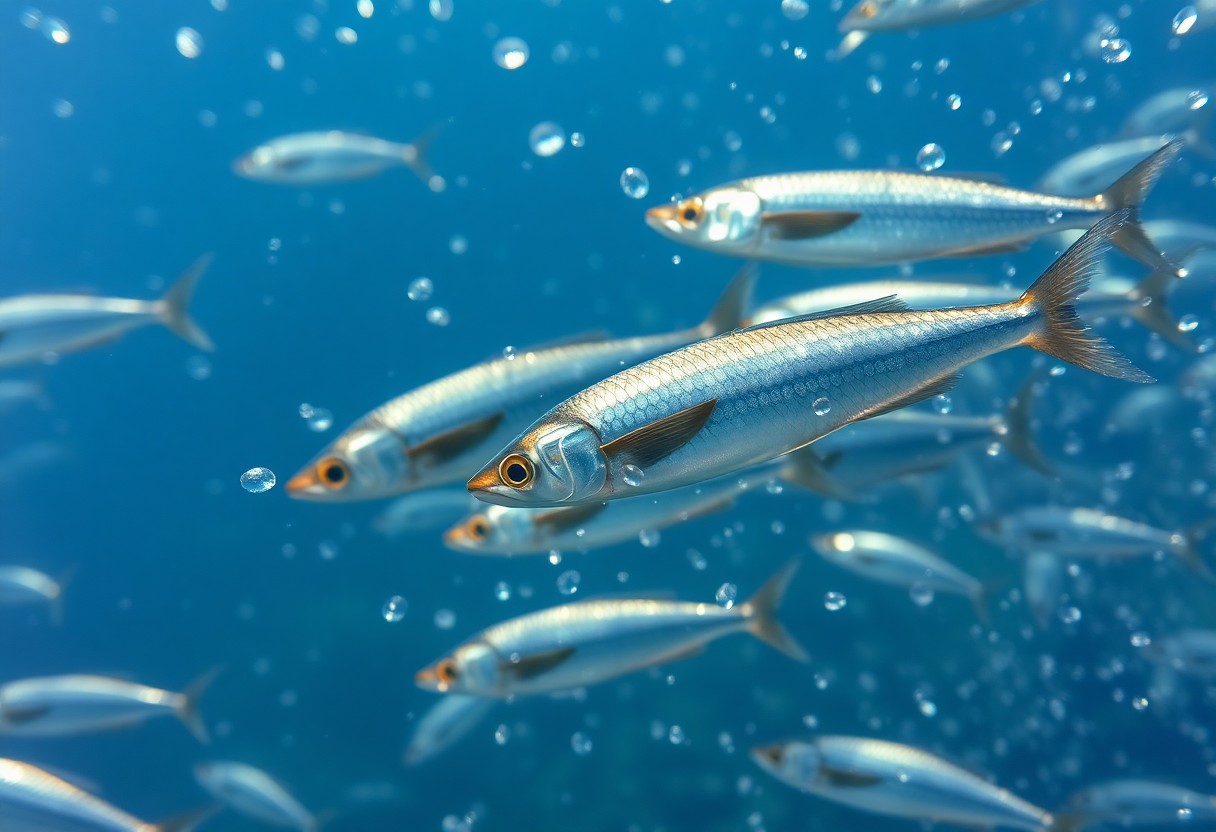
Sardines spawn in open water, where you should know they release eggs and milt for external fertilization, producing millions of planktonic eggs that face high predation yet benefit from mass spawning and rapid growth.
Primary Types of Sardine Spawning Environments
Sardines commonly spawn in nearshore coastal shelves, sheltered estuaries, and nutrient-rich upwelling zones; you monitor temperature, salinity, and predation when assessing sites.
- Coastal shelf
- Estuarine
- Open-ocean pelagic
- Upwelling zones
- Continental shelf edge
| Coastal shelf | Shallow waters, moderate currents; shelter but variable egg survival. |
| Estuarine | Lower salinity, protected spawning; predation concentrated near mouths. |
| Open-ocean pelagic | Buoyant eggs drift with currents; wide dispersion, higher advection loss. |
| Upwelling zones | Nutrient-rich plumes boost larval food and high survival potential. |
| Continental shelf edge | Strong currents and mixing create retention features that concentrate eggs. |
Knowing which spawning environment is used lets you predict egg dispersion and risks to recruitment; you can then prioritize monitoring in high-survival zones.
Pelagic Egg Dispersion Strategies
Eggs released in open water are often buoyant or semi-buoyant and drift with surface currents; you track them using current models to estimate dispersion and loss.
Currents and vertical mixing concentrate pelagic eggs in frontal zones where you may find elevated survival, while broad drift increases exposure to predation and advection.
Regional Variations Among Major Species
Species differ: you will see seasonal pulses in temperate taxa and extended or year-round spawning in tropical populations; local fisheries pressure often reduces effective recruitment.
Range shifts and local oceanography alter preferred habitats, so you should adjust sampling and management to protect high-value spawning aggregations under environmental variability.
Key Environmental Factors Affecting Reproduction
Sardine spawning success depends on multiple variables you should monitor: temperature, salinity, currents and food availability shape egg viability and larval survival; shifts in any can cause rapid declines in recruitment.
- sardine reproduction
- spawning temperature
- salinity
- ocean currents
- nutrients
Thermal Thresholds and Salinity Levels
Warmer waters within the species’ spawning window speed egg development, but if temperatures exceed the optimal temperature window you risk lower hatch rates; reduced salinity from runoff can cause egg mortality and larval stress you must anticipate.
The Influence of Ocean Currents and Nutrients
Currents aggregate plankton and larvae, so you often find better survival near persistent upwelling zones where nutrient-rich waters boost food availability and growth.
The spatial match between your spawning locations and nutrient-bearing currents controls whether you achieve larval retention for local recruitment or undesirable dispersal that reduces survival.
How Do Sardines Reproduce
Spawning occurs in seasonal pulses when adults form dense schools and release eggs and sperm into surface waters; you observe synchronized mass release that maximizes fertilization while increasing predation risk for eggs and adults.
Step-by-Step Overview of the Spawning Process
| Step | What you see |
|---|---|
| Aggregation | Adults form tight schools near spawning grounds. |
| Gamete release | Simultaneous release of eggs and sperm into the water column. |
| Fertilization | Fertilization occurs externally within minutes. |
| Egg drift | Pelagic eggs drift with currents and face high predation. |
| Hatching | Larvae emerge and begin feeding on plankton. |
Synchronized Schooling and Gamete Release
During spawning you notice schools compress and align so thousands release gametes within seconds; this near-simultaneous release increases fertilization rates but also creates a feeding bonanza for predators that reduces survival.
Developmental Phases from Egg to Larvae
Eggs are buoyant and pelagic, hatching in roughly 2-7 days depending on temperature; you will track that many eggs suffer high mortality from predators and unfavorable currents before larvae appear.
Larvae grow rapidly, relying on yolk reserves then switching to plankton within days; you should note that rapid development improves recruitment chances but most cohorts remain heavily thinned by predation and food scarcity.
Pros and Cons of the r-Selection Reproductive Model
| Pros | Cons |
|---|---|
| High fecundity | High juvenile mortality |
| Rapid population rebound | Minimal parental care |
| Wide larval dispersal | Dependence on abundant food |
| Quick colonization of openings | Boom-and-bust cycles |
| Maintains genetic mixing | High susceptibility to predators |
| Low energy per offspring | Poor resilience to prolonged scarcity |
Benefits of High-Volume Offspring Production
You gain an advantage when sardines flood the water with eggs because many offspring raise the odds that some survive environmental variation and allow for rapid recolonization after losses.
Vulnerability to Predation and Resource Scarcity
When you assess r-selected sardine cohorts, note that each larva has minimal protection, so mass predation and sudden food declines can decimate a year-class within weeks.
Because you rely on frequent, large spawning pulses, a single adverse event can trigger multi-year recruitment failure, stressing fisheries and predator populations that depend on predictable sardine abundance.
Professional Tips for Monitoring Spawning Activity
Use consistent sampling schedules so you can compare year-to-year spawning intensity; pair visual surveys with bio-acoustic transects and log sea surface temperature, salinity, and plankton counts to detect true aggregation events and rising egg density. Flag dangerous signs such as harmful algal blooms or persistent hypoxia that can cause mass egg loss.
- You should record nightly weather, moon phase, and tide to refine effort windows (seasonal windows).
- You should validate acoustic targets with targeted net tows to confirm sardines.
- You should map repeat transects to track persistent spawning hotspots and note areas of high predation risk.
Knowing you prioritize calibrated methods and cross-validation will increase confidence in spawn detection and reduce false positives.
Identifying Peak Seasonal Windows
Track multi-year trends in sea surface temperature and chlorophyll to identify recurring spawning windows, and use satellite data alongside local net tows so your timing is evidence-based.
Observe lunar phase and tidal cycles in your survey planning because you will often find sardines spawn near specific tides or new moons, and avoiding stormy periods reduces wasted effort.
Utilizing Bio-Acoustic Survey Methods
Deploy calibrated echosounders on repeat transects to quantify school density and depth; you should pair acoustic backscatter with net sampling to distinguish sardines from other forage fish.
Calibrate frequency and beam settings regularly and monitor ambient noise, since high noise levels can mask smaller schools and lead you to undercount spawning events.
Analyze acoustic time-series against egg and larval counts so you can separate transient feeding aggregations from sustained, high-density signals indicative of true spawning events.
To wrap up
To wrap up, you should know that sardines reproduce by broadcast spawning: females release thousands of buoyant eggs while males shed sperm into open water, enabling external fertilization. Eggs hatch into planktonic larvae that feed and grow in nutrient-rich currents, and seasonal cues plus synchronized schooling increase fertilization rates and genetic mixing, producing swift recruitment when conditions are favorable.