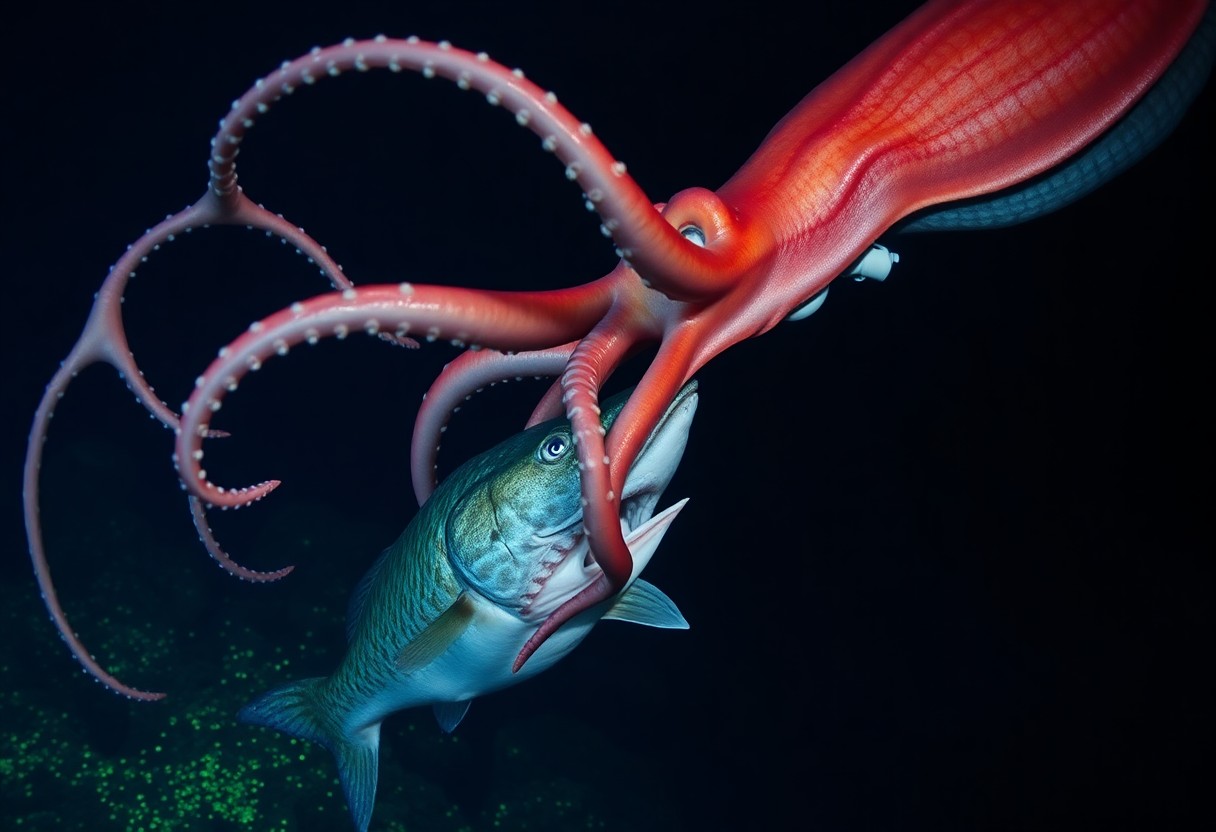
Squid in the deep hunt mostly fish and other cephalopods, and you learn they seize prey with long tentacles and a powerful beak; their stealth and strength make them effective deep-sea predators.
Types of Primary Deep-Sea Prey
Giant squid target midwater animals; you find deep-sea teleosts and smaller cephalopods most often in stomach and beak analyses.
Evidence from beaks and isotopes lets you estimate prey proportions, and you frequently record bioluminescent fishes and agile cephalopods.
- Deep-water teleost fish
- Smaller cephalopods
- Conspecifics (juvenile giant squid)
- Crustaceans
- Gelatinous organisms
| Teleosts | Lanternfish, grenadiers; energetically valuable |
| Smaller cephalopods | Short-finned squid, octopod paralarvae; agile prey |
| Conspecifics | Juveniles and small adults; cannibalism evidence |
| Crustaceans | Amphipods and shrimps; abundant but small |
| Gelatinous | Jellyfish and siphonophores; easy capture, low energy |
Deep-Water Teleost Fish Species
Many deep-water teleosts you encounter, such as lanternfish and grenadiers, provide dense calorie packages that a giant squid can target during vertical forays.
Smaller Cephalopods and Intraspecific Competition
Smaller cephalopods you observe act as both prey and occasional competitors, and their agility forces you to invest in rapid strikes and powerful handling with the beak.
Conspecifics sometimes clash over captures, so you record tentacle scars and ingested smaller squids in samples.
Perceiving these interactions helps you interpret how intraspecific competition shapes hunting ranges and prey selection.
Factors Influencing Dietary Selection
Dietary shifts depend on prey availability, your hunting range and the energetic payoff; you prioritize energy-dense prey to sustain growth and long forays, while morphological limits steer you toward certain sizes and types of prey.
- prey abundance
- energy density
- foraging depth
- morphology
- competition
Selection also reflects seasonal migrations and competitor pressure, so you switch targets when risks rise or returns fall, favoring scavenged carrion or large fish when hunting costs spike.
Metabolic Energy Demands for Massive Growth
Metabolic demands force you to seek frequent, high-calorie meals; sustaining rapid growth and reproductive investment means targeting prey that maximizes calories per strike while minimizing pursuit time.
Environmental Constraints of the Bathypelagic Zone
Pressure, cold and darkness restrict prey behaviors and sensory cues, making some food scarce and others dangerous to chase, so you rely on tactile and bioluminescent signals to locate suitable targets.
Perceiving faint bioluminescence and subtle hydrodynamic cues, you adapt by ambushing or scavenging, conserving oxygen and energy while competing with other deep predators for limited resources.
Step-by-Step Mechanics of the Hunt
You observe the hunt as a sequence: visual detection, a silent approach, explosive tentacle extension, and beak processing, each step driven by speed, reach, and a razorlike beak that ends the struggle.
Depths strip away light and force you to rely on specialized anatomy, so the squid converts faint bioluminescent cues and mechanical feedback into decisive action that maximizes capture success.
| Stage | Your Role |
|---|---|
| Detection | You pick out faint bioluminescence with oversized eyes. |
| Approach | You close softly using steady, low-drag movements. |
| Strike | You extend tentacles rapidly and secure prey with powerful suckers. |
| Processing | You use the sharp beak and radula to cut and ingest tissue. |
Sensory Detection Using Oversized Eyes
Eyes capture scarce photons so you can detect moving prey from meters away; their scale enhances low-light sensitivity, turning faint glows into clear directional cues.
Tentacle Strike and Beak Processing
Tentacles accelerate outward so you can bridge distance before prey reacts, using extended reach and speed to position suckers for a secure hold.
Suction cups clamp and hook onto struggling flesh while you maintain control, with their structure preventing escape even during violent thrashing.
Beak and radula then process the catch so you can ingest it efficiently, the sharp beak slicing tissue and the rasping radula breaking it into swallowable pieces under extreme pressure.
Pros and Cons of Apex Predation in the Abyss
You gain access to scarce, calorically rich prey by occupying the apex niche, which lets you sustain large body size and long dives. This role exposes you to extended hunting expeditions, unpredictable prey availability, and occasional injuries from powerful prey or conspecific conflict.
Predation at depth demands specialized hunting strategies and endurance, increasing your metabolic costs and time between successful feeds. It can also reduce predation pressure from above, giving you relative ecological freedom compared with midwater species.
| Pros | Cons |
|---|---|
| Access to high-calorie, large prey | Huge energy expenditure during long hunts |
| Fewer natural predators targeting adults | Irregular food supply creates starvation risk |
| Ability to support large body size and reproduction | High risk of injury from powerful prey |
| Competitive advantage over smaller predators | Dependence on patchy prey distributions |
| Opportunity for rare, energy-rich meals | Extended fasting between successful captures |
| Specialized feeding tactics reduce waste | Large search ranges increase exposure to hazards |
| Supports long-term survival when successful | Reproductive success tied to unpredictable prey |
| Ecological influence on deep-food webs | Population vulnerability to ecosystem shifts |
High Nutritional Rewards of Specialized Prey
Specialized prey such as large fish, squid, and deep-swimming crustaceans supply you with high-density lipids and proteins, supporting prolonged dives and reproductive investment. These meals let you recover quickly and maintain size without continuous foraging.
Extreme Energy Expenditure and Scarcity Risks
High metabolic demands of hunting at depth mean you expend tremendous energy locating and capturing prey, increasing the chance of failed hunts. You often face long fasting periods where a missed opportunity becomes a matter of survival.
Hunting large, agile prey risks injury from powerful tentacle strikes or beak bites, and pursuing scattered prey forces you into wider search patterns that raise exposure to other predators and environmental hazards.
Energy budgets for you hinge on rare, high-payoff captures; when prey density drops, your survival is threatened by extended starvation and reduced reproductive output, making apex status both rewarding and precarious.
Tips for Identifying Productive Feeding Habitats
Observe water-column indicators where you find Giant Squid prey: tight prey schools, sharp thermoclines and baitfish aggregations. Use acoustic surveys and eDNA to map feeding habitats and flag bioluminescent layers that concentrate prey.
- Prey hotspots: dense baitfish or squid schools
- Thermal fronts: sharp temperature gradients
- Seafloor features: canyon edges and slope breaks
Track seasonal shifts, salinity gradients and frontal persistence to predict where prey accumulates; watch for hypoxic areas since oxygen minimum zones can attract and stress prey. Thou should focus on convergence zones and dense prey layers when planning surveys.
Analyzing Ocean Current and Upwelling Patterns
Map ocean currents and upwelling with satellite SST, altimetry and in situ profiles so you identify nutrient-rich inflows that boost prey; persistent upwelling often creates the most reliable prey hotspots.
Monitoring the Movements of Deep-Diving Competitors
Monitor tagged deep-divers like sperm whales and large predatory fish because their foraging paths reveal overlapping feeding habitats, giving you indirect cues about squid prey distribution through acoustic and visual observations.
Compare competitor dive depths and timing with your prey echoes to pinpoint depth bands where Giant Squid likely feed and treat sudden predator congregations as strong indicators of abundant prey.
Conclusion
Conclusively, you observe that giant squid feed mainly on deep-sea fish and other squids, using long tentacles and hooked suckers to seize prey and a powerful beak to dismember it. You can rely on stomach content analyses and predator interactions showing opportunistic hunting of lanternfish, hake, and smaller cephalopods across varying depths.