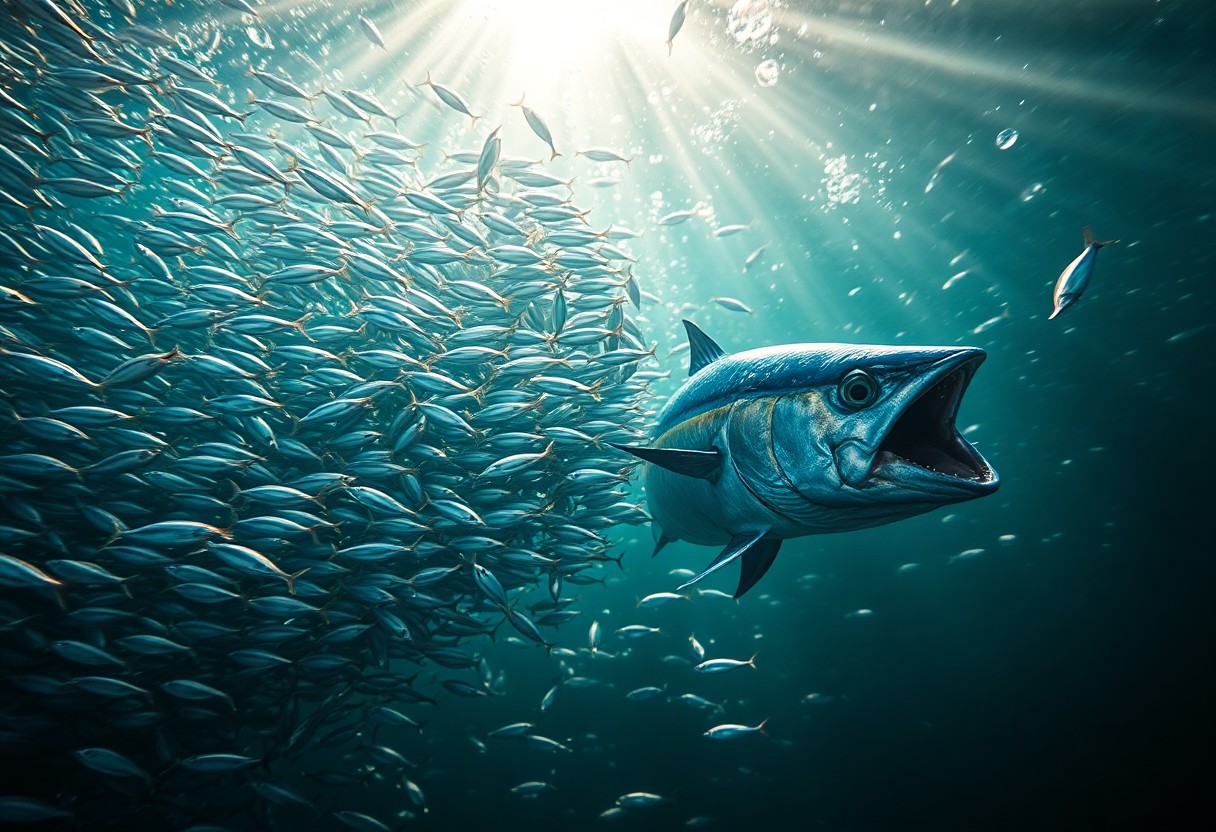

Just watch a sardine school and you see how they protect themselves: they form tight schools, perform synchronized turns, emit silver flashes to confuse, and burst away from fast predators.
How Do Sardines Protect Themselves – Types of Collective Defensive Formations
Sardines form several group strategies so you witness reduced individual risk when predators arrive: tight bait balls, elongated shoals, sudden flash expansions, and slower-moving toroidal rings. Each formation shifts how a predator targets prey and how you interpret their behavior in the water.
These formations rely on coordinated movement to create a confusion effect and improve hydrodynamic efficiency, which lowers energy cost and exposure for you as an individual fish. Pay attention to cluster density and direction changes as indicators of threat and escape tactics.
- Bait ball
- Shoaling
- Flash expansion
- Toroidal ring
| Formation | Primary function |
| Bait ball | Mass confusion to dilute predation |
| Shoal | Coordinated travel with energy savings |
| Flash expansion | Sudden radius increase to startle predators |
| Toroidal ring | Encircle and isolate threats |
The Mechanics of the Bait Ball
When predators concentrate, you will see sardines compact into a dense bait ball where overlapping movement makes individual targeting difficult and boosts the confusion effect. Predators face visual overload, which buys you crucial escape seconds.
Bait balls also change local flow so you gain small hydrodynamic benefits and reduced swim cost while under attack; this shared effort helps you maintain stamina during repeated strikes by predators.
Synchronized Shoaling Patterns
Shoals display tight alignment so you match neighbors’ speed and turning, creating a unified front that reduces individual exposure and transmits predator cues instantly. That synchronization lowers the chance that you will be singled out.
You can observe synchronized turns and spacing changes as real-time alarms; those shifts often precede a defensive formation and signal you to tighten or expand with the group.
Recognizing these cues lets you anticipate predator tactics and choose safer positions within the group, improving your survival odds when threats appear.
Factors Influencing Defensive Success
Sardines adjust their defensive output based on what you observe in the field: tight schooling, sudden turns, and synchronized flashes that confuse predators and reduce individual targeting.
- Schooling cohesion – density and alignment
- Water clarity & light penetration
- Predator velocity and hunting tactics
- Group size and individual burst speed
Schooling effectiveness depends on how well you maintain alignment and density under stress; increased cohesion amplifies the confusion effect while making approach angles less predictable. This effect can sharply lower strike success when visibility favors the group over a lone predator.
Water Clarity and Light Penetration
Clear water changes what you must monitor: higher visibility allows predators to pick out stragglers but also helps you detect incoming strikes earlier and coordinate evasive maneuvers.
Light patterns alter silhouette and contrast so you should watch how shadows and shafts of light affect concealment; low light can grant passive camouflage, while bright backlighting creates dangerous outlines that aid attackers.
Predator Velocity and Hunting Tactics
Predator speed shortens the reaction window you rely on: faster bursts demand near-instant collective responses and reduce the margin for error in your evasion timing.
Speed variation and ambush strategies change which defenses win; sudden high-speed strikes favor solitary chases while coordinated herding and cooperative tactics exploit gaps in your schooling and increase your vulnerability.
This deeper look shows you that predators adjust approach angles and timing based on currents and light, so prioritizing tighter formation, burst swimming, and directional flashes will reduce strike accuracy from the fastest attackers.
Step-by-Step Response to Predator Detection
Response Steps
| Step | Action |
|---|---|
| Detection | You sense pressure changes and visual cues via the lateral line and eyes. |
| Alignment | You match speed and direction with neighbors to prepare a collective response. |
| Flash Expansion | You execute a sudden outward burst to break the predator’s focus. |
| Reform | You tighten back into the school to regain protection. |
Rapid Sensory Identification of Threats
Lateral line receptors and vision provide you with split-second information about approaching disturbances, allowing immediate threat recognition. You detect subtle pressure waves and sudden shadow changes that indicate a predator is closing in.
Execution of the “Flash Expansion” Maneuver
Synchronized acceleration sends you outward in a rapid bloom that creates a flash expansion, scattering the school and disrupting the predator’s targeting. You push speed and angle simultaneously so the group presents many moving targets at once.
Coordination depends on visual alignment and water-flow cues so you time the burst within milliseconds; that shared timing produces mass confusion and lowers the predator’s strike success. You rely on close neighbor reactions to maintain the pattern.
Afterward you reform quickly into tight ranks to restore collective defense, since close-range strikes remain the most dangerous phase and rapid regrouping reduces individual exposure.

Tips for Observing Defensive Behaviors in the Wild
Observe from a steady position and let sardines settle; you should avoid sudden movements that break the school’s pattern and attract predators. Use polarized lenses or a mask to study the bait ball shape while keeping a safe distance.
- Maintain distance – use binoculars or a zoom lens.
- Minimize noise – reduce engine and splash disturbance.
- Record behavior – short videos capture tightening and escape maneuvers.
Keep observation sessions brief and noninvasive to limit agitation in the school. This helps protect the animals and reduces your exposure to hunting predators.
Optimal Timing for Marine Observation
Evening and dawn concentrate predator activity, so you should plan trips around low light when bait ball defenses are most visible. Tidal shifts and calm seas also improve sightlines and safety.
Identifying Agitation and Tightening Signals
Watch for rapid, synchronized turns, sudden density increases, and shimmering flashes-these are clear signs of agitation and initial tightening as the school responds to threat.
Note intensified bird activity, splashing, or silhouettes below the surface; those cues often precede a dangerous attack and signal you to back away and observe from farther off.
Focus on documenting the sequence-timing, predator type, and how the school compresses-while maintaining safe distance and never chasing the animals or altering their behavior.
Pros and Cons of the Schooling Strategy
| Pros | Cons |
|---|---|
| Lower individual predation risk | Higher visibility to large predators |
| Improved foraging efficiency | Susceptibility to mass-netting |
| Hydrodynamic energy savings | Disease transmission within schools |
| Collective sensing and response | Increased resource competition |
| Predator confusion during attacks | Bycatch risk for other species |
| Enhanced mating opportunities | Rapid population decline after heavy harvest |
| Social learning of routes and feeding | Reduced per-individual growth under crowding |
| Improved juvenile survival rates | Dependence on group cohesion for defense |
Advantages of the Dilution Effect
Sardines cluster so you experience a lower chance of being singled out, as the dilution effect spreads predator risk across many individuals. You also benefit when predators hesitate or mis-target, giving each fish a better chance to escape.
Vulnerability to Mass Harvesting and Netting
Nets and purse seines can encircle entire schools, so you face mass mortality during a single haul that removes hundreds or thousands of individuals. You should expect rapid local declines if fishing is intense and unregulated.
Commercial operations often use sonar, spotter planes and lights to find schools, making you especially exposed to targeted harvest and overfishing; recovery can be slow once removals exceed reproductive replacement, so management and enforcement directly affect your long-term survival.
Final Words
Now you know how sardines protect themselves: they form dense schools that dilute risk, use synchronized turns and sudden bursts to confuse predators, and rely on reflective, silvery scales and countershading to blend in open water. You can appreciate how group behavior outweighs individual defenses.