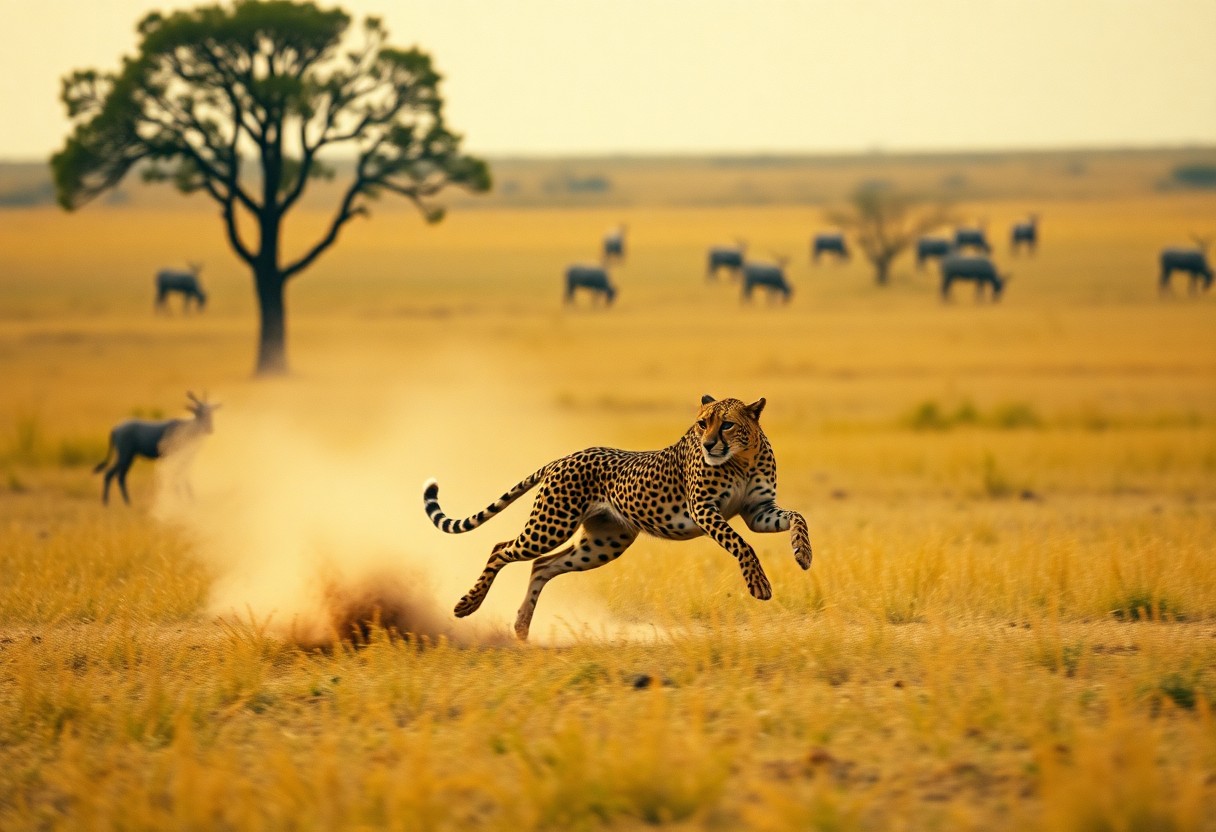
There’s a precise hunting profile you should know: cheetahs target small to medium ungulates, rely on incredible acceleration, and avoid confrontations with larger predators, so you can better understand their behavior in the wild.
Common Prey Types in the Cheetah’s Habitat
Cheetahs target animals that suit their sprinting ability, so you will most often see them pursue small to medium antelopes and vulnerable young ungulates. They prefer prey in open grass where bursts of speed win chases, and you should note that calves and weakened adults are frequent victims.
Grasslands and savanna edges concentrate herds, which lets you predict hunting spots based on visibility and water sources; you will notice seasonal shifts toward smaller or younger prey when cover or calf births change. The list below summarizes common types.
| Thomson’s gazelle | Preferred, agile, fast |
| Impala | Common medium antelope, often targeted |
| Springbok | Open plains species, vulnerable to sprints |
| Steenbok | Smaller species taken near cover |
| Hares/Game birds | Occasional, opportunistic targets |
- Thomson’s gazelle
- Impala
- Springbok
- Steenbok
- Hares & game birds
Preferred Small to Medium Antelopes
Smaller antelopes like Thomson’s gazelle and impala match the cheetah’s hunting style, so you will see hunts built around short, explosive chases and tactical stalking. You should watch for hunts near open patches where speed, not strength, decides the outcome.
Occasional Targets: Hares and Game Birds
Hares and ground-dwelling game birds become targets when larger prey is scarce, and you will observe cheetahs using stealth and quick pounces rather than long runs to catch them.
Seasonally you may see shifts toward these smaller prey after fires or during droughts, and you will note how agility and surprise replace endurance in successful captures. Any time you watch a hunt for hares or game birds, pay attention to how stealth and acceleration substitute for long chases.
Critical Factors Determining Hunting Success
You evaluate prey species, herd size and vigilance, and the presence of competitors when judging hunting success. Small antelope like Thomson’s gazelle offer high reward with lower injury risk, while larger ungulates increase your chance of injury and energy loss. Wind direction and herd spacing shape approach options.
Hunting at dawn or dusk reduces detection and lets you use speed and short bursts to close distance; daytime heat can sap endurance. You also factor in vegetation density and patrol routes of lions and hyenas, which raise the dangers of kleptoparasitism and direct conflict.
- cheetah hunting
- hunting success
- terrain suitability
- visual cover
- seasonal migration
- prey availability
Terrain Suitability and Visual Cover
Open savanna with short grass favors your sprinting technique, but scattered bushes provide necessary concealment for a close-range launch. You time approaches to exploit glare and shadow, minimizing detection while risking ambush by larger predators if cover becomes too dense.
Seasonal Migration Patterns of Prey
Migration concentrates prey along predictable corridors and water points, giving you windows of abundant prey availability. You monitor rains and calving peaks to position hunts near choke points where herds slow and vulnerability rises.
Assume that droughts and human encroachment alter migratory timing, forcing you to follow nomadic herds or switch to resident species, which increases encounters with competitors and raises the need for opportunistic, risk-aware hunting.
Step-by-Step Breakdown of the Cheetah’s Attack
Attack phases
| Phase | What you observe |
|---|---|
| Approach & Stalk | You see a low profile, use of cover, closing to 10-30 m |
| Sprint | Short high-speed burst, rapid acceleration over open ground |
| Takedown & Kill | Trip or throat bite to suffocate, dangerous for prey, quick consumption |
Stealthy Approach and Stalking Phase
Silent stalking forces you to stay motionless while the cheetah crouches low and uses grass and terrain to close the gap; you notice it times movement to wind direction and herd distractions to avoid detection.
The High-Speed Sprint and Takedown
Explosive acceleration sends the cheetah into a brief, intense chase that you can only follow for a few dozen seconds, so the animal relies on burst speed rather than endurance.
During the final meters you watch the predator aim to trip or target ankles, then latch onto the throat to suffocate prey, a forceful and efficient finish that ends the hunt quickly.
Pros and Cons of Solitary Hunting Strategies
You gain stealth and the freedom to hunt without sharing, but you also face increased exposure and higher risk when a chase fails.
| Pros | Cons |
|---|---|
| High speed utilization | Susceptible to kill theft |
| Minimal need to share prey | Cannot subdue very large prey alone |
| Stealthy stalking | High energy cost per successful hunt |
| Quick, autonomous decisions | No cooperative flushing of prey |
| Lower disease transfer within groups | Attractive to scavengers |
| Flexible territory use | Unassisted defense of kills |
Benefits of Agility and Specialized Speed
Agility and specialized speed let you close distance rapidly, outpace burst-capable prey, and complete chases before competitors can intervene.
Vulnerability to Scavengers and Kill Theft
Scavengers and larger carnivores track fresh kills, forcing you to abandon meat or risk confrontation that can result in immediate kill theft.
Defending a carcass drains your energy and can leave you without a meal when dominant predators exploit your vulnerability.
Essential Tips for Tracking Cheetah Predation
Use spoor, droppings and fresh kills to pinpoint active cheetah predation sites; factor wind, cover and herd movement so you time observations when visibility is best. Carry optics, log GPS points and maintain distance to avoid altering the hunt.
- Hunting windows: target early morning and late afternoon when prey are most active.
- Stalking signs: watch bent grasses, low tracks and focused gaze from nearby cheetahs.
- Safety: stay downwind and observe from a vehicle or concealed vantage.
Identifying Optimal Hunting Windows
Observe dawn and dusk temperature shifts and herd movements to spot when hunting chances rise; lower light reduces prey vigilance and increases cheetah success. Use recent sightings and local weather patterns to schedule short, focused stakeouts.
Recognizing Pre-Hunt Stalking Behaviors
Watch low posture, slow deliberate steps and a fixed stare as classic stalking cues; these behaviors minimize detection and set up a high-speed chase. Note when individuals tuck tails and flatten ears, which signals intent to close the gap.
Move quietly to record pauses, direction changes and flank positioning-those microbehaviors reveal target choice and the imminent danger of a sprint, so you must photograph from a safe distance and avoid interference.
Thou should also compare solitary versus coalition approaches, since group hunts alter pace, target selection and sign interpretation for more accurate field assessments.
To wrap up
On the whole, you can expect cheetahs to hunt mainly small to medium ungulates-Thomson’s gazelles, impala, young wildebeest-along with hares and ground birds; you observe fast, daylight chases and short bursts of speed to catch prey, then suffocation by biting the throat. You appreciate their specialization for open grasslands and prey that match their sprinting strategy.