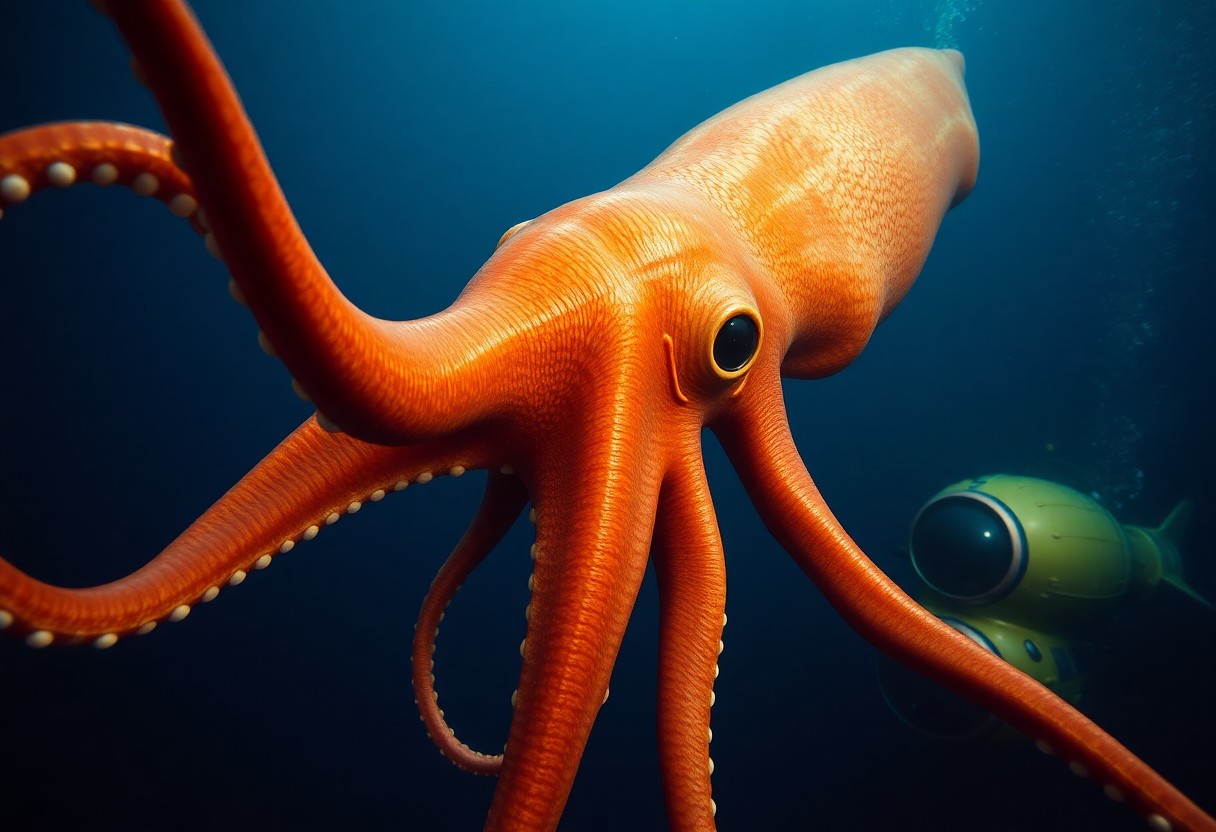
You should know giant squid can reach about 13 meters (43 feet) and weigh several hundred kilograms; their long tentacles and powerful beak make them dangerous, while deep-sea adaptations make them resilient and impressive.
Types of Massive Cephalopod Species
Explore the range of massive cephalopods you may study, noting species known for extreme size and deepwater habits.
- Giant squid (Architeuthis)
- Colossal squid (Mesonychoteuthis)
- Giant Pacific octopus
- Vampire squid
Quick species comparison
| Giant squid | Up to ~13 m total length |
| Colossal squid | Shorter but much heavier |
| Typical habitat | Deep, cold ocean zones |
| Predators | Sperm whales |
| Notable trait | Enormous eyes and long tentacles |
After you compare features, use size, weight, and arm structure to classify specimens.
The Giant Squid (Architeuthis dux)
Giant Architeuthis dux can reach around 10-13 m in total length, and you should note their elongated feeding tentacles and huge eyes for low-light hunting.
Giant squid facts
| Max length | ~10-13 m |
| Arm structure | 8 arms + 2 long tentacles |
| Eyes | Up to 25 cm diameter |
| Behavior | Deepwater ambush predator |
| Threats | Predation by sperm whales |
Comparisons with the Colossal Squid
Compare the colossal squid with the giant by noting that you will find the colossal is shorter in length but heavier and more powerfully built, with swiveling hooks on its arms.
Colossal vs Giant
| Length | Giant longer (~10-13 m) |
| Mass | Colossal heavier (up to several hundred kg) |
| Arm hooks | Colossal has stronger hooks |
| Body | Colossal more robust |
| Eyes | Giant has larger eyes |
Next you should consider that the colossal squid’s mass and hooks make it potentially more dangerous in close encounters, and you can use beak size and mantle robustness to tell them apart.
Additional comparison details
| Feeding | Both are active predators |
| Depth | Both inhabit deep cold waters |
| Specimen rarity | Colossal specimens are rarer |
| Research value | Both provide key insights into deep-sea ecology |
| Identification tip | Check tentacle length vs mantle girth |

Factors Influencing Biological Growth Limits
- Giant squid
- Growth limits
- Deep-sea gigantism
- Resource density
- Mesopelagic
- Metabolism
You assess how physiology, energy budgets, and ecological interactions combine to set a squid’s maximum size, noting that oxygen availability and metabolic rate are decisive factors that either enable or restrict growth.
Consider genetic ceilings and predation-driven mortality when estimating theoretical maxima, and weigh reproductive trade-offs against somatic growth. Assume that localized resource fluxes and predator pressure define realistic size ceilings for any given population.
Deep-Sea Gigantism and Resource Density
Low temperatures and reduced predator encounters in deep waters let you allocate energy toward larger bodies, and a slow metabolism can extend growth longevity when food is predictable.
Resource pulses such as whale falls or seasonal fluxes let you exceed surface size norms briefly, since high resource density spikes provide the caloric surplus needed for disproportionate growth.
Environmental Constraints of the Mesopelagic Zone
Oxygen minimum zones in the mesopelagic force you to compress activity and favor smaller, more efficient shapes; persistent low oxygen is a strong limiter on sustained growth.
Pressure, diminished light, and limited prey visibility increase maintenance costs, so you incur an energy cost that often caps maximum attainable size.
Temperature gradients further slow biochemical rates, making your growth opportunistic and tightly coupled to transient food availability and metabolic trade-offs.
Step-by-Step Methodology for Accurate Measurement
Measurement Steps
| Step | Action |
|---|---|
| Prepare equipment | Calibrate calipers, scales, and photo scale bars |
| Measure mantle | Record dorsal midline mantle length with flexible tape |
| Measure tentacles | Measure fully extended tentacles or estimate from base/sucker counts |
| Document condition | Note damage, contraction, and preservation state |
| Estimate mass | Use beak/gladius regressions if whole-animal mass unavailable |
This protocol keeps your data comparable across studies by enforcing fixed landmarks and metadata fields so you avoid inflated totals from stretched tentacles; record gear calibration and specimen condition with each entry and flag any suspect measurements.
You should photograph scale bars, note preservation effects, and store raw values alongside derived metrics so future reanalysis can correct for estimation biases and produce consistent datasets.
Standardizing Mantle vs. Tentacle Length
Measure mantle length along the dorsal midline and record whether you measure dorsal or ventral curves; for tentacles, measure only intact, fully extended tissue and mark reconstructions separately so you never mix mantle and tentacle values in the same field, preserving measurement integrity.
Estimating Mass from Beak and Gladius Analysis
Use rostral beak dimensions and gladius length in published regression equations to estimate total mass when an intact specimen is unavailable; you must account for ontogenetic stage and regional variation, and handle the beak carefully because of its sharp edges.
When you apply these models, include confidence intervals and validate estimates against measured specimens whenever possible to improve the reliability of your mass estimates.
Tips for Professional Specimen Identification
Use standardized measurements and photographs to record mantle length, tentacle proportions, and beak size; collect tissue for genetic confirmation and log depth and location for each find.
- Measure mantle length with scale bars
- Photograph sucker serrations and tentacle clubs
- Submit tissue for Architeuthis barcoding
Compare features to museum records and consult specialists before certifying identity. Thou must not handle large specimens alone, since giant squid remnants can present sharp serrations and entanglement hazards.
Recognizing Unique Sucker Serrations
Inspect sucker rings under magnification and count projections; sucker serrations in true Architeuthis show asymmetric, tooth-like patterns that differ from smaller species. You should photograph serration rows with a scale for later comparison.
Distinguishing Juvenile Giants from Adult Smaller Species
Observe proportional cues: juveniles have adult-style sucker serrations but proportionally shorter mantles and different tentacle club ratios, so compare specimens against ontogenetic charts to avoid misidentification.
Note that genetic barcoding is the definitive test when morphology overlaps; you should submit tissue samples and labeled images to reference labs for confirmation.
Pros and Cons of Extraordinary Physical Scaling
| Pros | Cons |
|---|---|
| You gain greater reach for capturing larger prey. | You demand far more oxygen and nutrient transport. |
| You deter many would-be predators through sheer size. | You endure much longer development and maturation times. |
| You access food sources unavailable to smaller individuals. | You require stronger support and locomotor structures. |
| You can store larger energy reserves for lean periods. | You risk uncontrolled sinking if buoyancy regulation fails. |
| You benefit from increased thermal inertia in cold depths. | You face greater detectability from acoustic and visual predators. |
| You may dominate reproductive competition at certain sizes. | You must invest heavily in specialized circulatory systems. |
| You open opportunities to exploit novel ecological niches. | You suffer slower recovery from injury and disease. |
| You often achieve longer maximum lifespans. | You incur steep energetic costs to maintain physiology. |
Size changes the balance of advantages and liabilities, so you must weigh how increased prey access and deterrence against predators trade off with the internal demands of a larger body. Oxygen limitation and transport bottlenecks emerge quickly as size grows.
Scale also alters life history: you may gain ecological dominance yet adopt slower reproduction and greater maintenance burdens, which can reduce population resilience under rapid environmental change.
Evolutionary Advantages of Large Size
Larger individuals let you tackle bigger prey and occupy niches that smaller competitors cannot, granting a clear feeding advantage and potential mate dominance. Competitive edge often translates into better survival odds in sparse deep-water systems.
You commonly experience reduced predation once you exceed certain thresholds, but that advantage reshapes reproductive strategies toward fewer, better-provisioned offspring and altered population dynamics.
Metabolic and Buoyancy Challenges of Gigantism
Metabolism scales nonlinearly, meaning you must sustain much higher absolute oxygen uptake; failure produces rapid tissue hypoxia during exertion. Circulatory and respiratory adaptations become limiting factors for further growth.
Buoyancy control becomes precarious as mass increases: you rely on tissue density adjustments and fluid management, and any failure raises the risk of catastrophic sinking below survivable depths.
Pressure magnifies these issues because you will need reinforced structures and biochemical stability to keep organs functional under compression, driving up the energetic costs and setting practical upper limits on achievable size.
Summing up
Considering all points, you should expect a giant squid to have a mantle roughly 2-2.5 meters long and a total length commonly reaching 10-13 meters, with some unverified reports up to 18 meters. You can expect mass in the low hundreds of kilograms, and size will vary by sex, age, and measurement method, so verified specimens give the most reliable estimates.