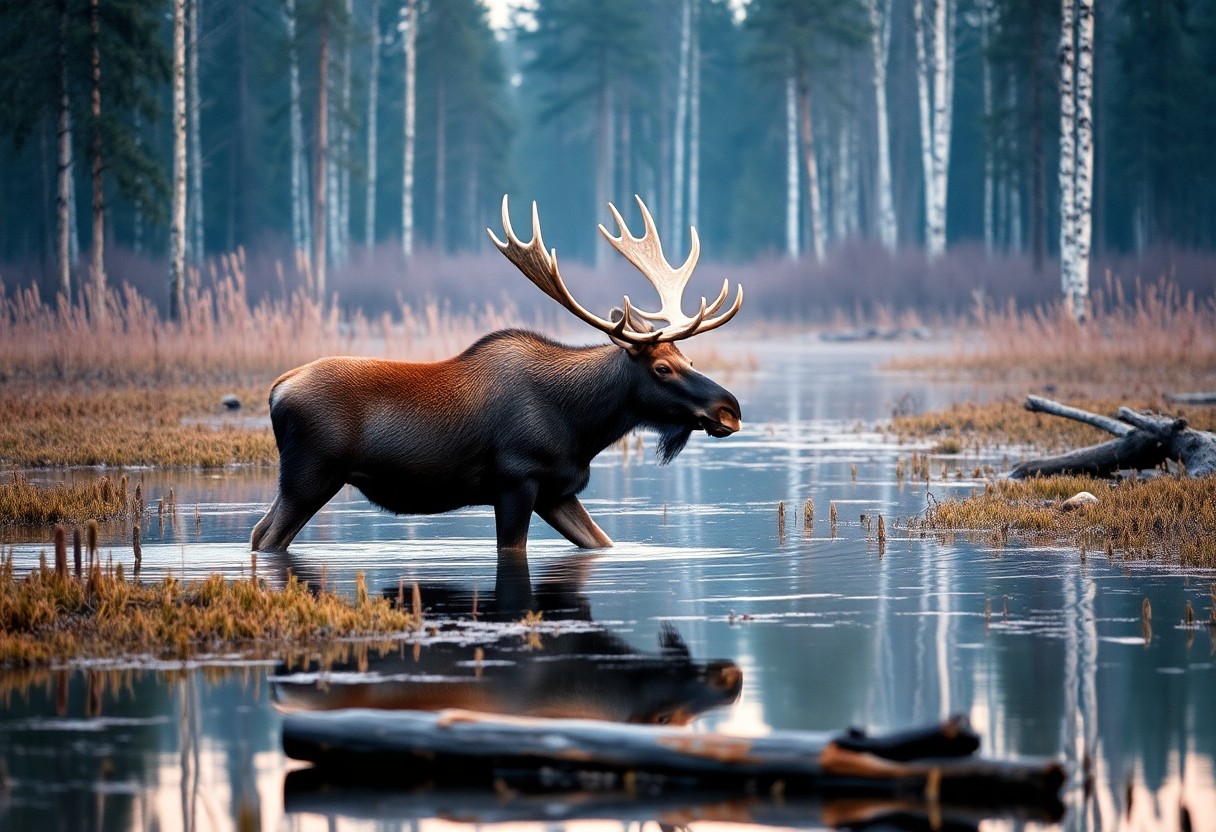
Just know that you will encounter moose in boreal forests, marshes, and riparian zones; they thrive in cold climates and can be aggressive when surprised or protecting calves, so you must keep a safe distance.

Primary Types of Moose Habitats
Moose concentrate where you find a mosaic of forest and water, favoring locations that offer both cover and forage. You will often see them near young conifer stands, wetlands, and river corridors where abundant forage supports seasonal weight gain.
Knowing how each moose habitat differs lets you map movements, identify dangerous zones like thin ice or road crossings, and set management priorities.
- Boreal Forests and Taiga Regions
- Wetlands, Marshes, and Riparian Zones
- Mixed Woodlands and Shrubland
- Tundra and Alpine Meadows
- River Valleys and Floodplains
| Boreal/taiga | Dense conifers, abundant browse, seasonal deep snow |
| Wetlands/riparian | Aquatic plants, calving cover, soft-ground hazards |
| Mixed woodlands | Edge habitat with varied browse and shelter |
| Tundra/alpine | Summer forage patches, exposed to weather |
| River valleys | Corridors for movement and winter browse concentrations |
Boreal Forests and Taiga Regions
Taiga offers the patchy mix of young trees and wetlands you need to observe moose browsing on willows and aspens; the combination gives abundant forage and cover, though deep snow can restrict movement and increase predation risk.
Wetlands, Marshes, and Riparian Zones
Wetlands supply the aquatic vegetation you rely on to find fattening summer forage and provide secluded calving cover, but they also hide dangerous soft soils and predator ambush sites that affect survival.
Seasonally flooded areas shift water depth and plant communities, so you must track hydrology and disturbance to understand changes in forage availability and calf access.
Critical Factors Influencing Habitat Selection
- Water/Wetlands
- Cover
- Forage
- Mineral Licks
- Snow Depth
- Human Disturbance
- Climate
Moose select habitats that balance water, cover, and forage, so you prioritize wetlands and riparian zones for feeding and calving. Deep snow and limited browse increase energetic costs and can push you into lower-elevation refuges where predation risk may rise.
Terrain such as elevation and distance from roads shapes occupancy, and you often avoid high-disturbance zones where human development fragments movement corridors. Maintaining connected patches of cover supports seasonal migrations and reduces exposure to stressors.
Thermoregulation and Climate Sensitivity
Cold microclimates in conifer stands reduce your heat loss during winter, while shaded wetlands and cool streams let you escape heat stress and biting insects in summer. Tick outbreaks and warmer winters can lower body condition and calf survival, so you rely on a mosaic of thermal refuges.
Forage Quality and Mineral Access
Spring flushes of willow and aquatic plants provide high-energy browse that supports lactation, so you track these patches and nearby mineral licks for sodium and calcium. Overbrowsed or low-diversity stands force you to expand ranges and increase time spent foraging.
Access to varied plant communities lets you balance protein and energy needs across the year, with aquatic plants offering easy calories in summer and shrubs sustaining you in winter. Overuse of fragile meadows can lead to nutrition deficits and higher predation risk. Any management that secures forage diversity and protects mineral sites benefits moose populations.
Step-by-Step Guide to Locating Active Moose Ranges
| Signs and Search Actions | |
|---|---|
| Tracks & Trails | Follow feeding trails and shoreline paths where you see fresh prints. |
| Browse & Bark | Inspect willow, aspen, and birch for clipped stems and scuffed bark. |
| Wallows & Bedding | Check wetlands for wallows and low brush for shallow depressions. |
| Scat & Scent | Note fresh scat and scent posts to map recent activity while keeping distance from aggressive bulls. |
Analyzing Vegetation Browse and Tracks
Tracks that are deep and fresh indicate nearby movement, so you should follow the direction and flag routes toward likely feeding areas while avoiding close confrontations.
Browsed stems and peeled bark on willow and aspen show preferred forage, so you should map those patches as high-probability sites for bedding and foraging and mark any hazardous terrain.
Identifying Seasonal Migration Corridors
Migration routes often follow river valleys and low ridges, so you should scout choke points during spring thaw when animals concentrate and record seasonal bottlenecks.
Snow cover and aerial imagery reveal linear clearings and fence gaps that you can use to trace likely corridors, but watch for hidden hazards such as thin ice at crossing areas.
Mark corridor edges on your map and set observation points downwind of crossings so you can study movement patterns while maintaining a safe distance from rutting bulls.
Pros and Cons of Different Forest Successions
Pros and Cons of Different Successional Stages
| Pros | Cons |
|---|---|
| High shrub and browse availability | Increased exposure to predators |
| Abundant young willow and aspen shoots | Short-lived food peaks |
| Easier movement and wallowing sites | Less winter thermal cover |
| Greater forage diversity seasonally | Patchy distribution of resources |
| Rapid vegetation regrowth after disturbance | Higher human disturbance near regenerating areas |
| Open sightlines for navigation | Reduced hiding cover for calves |
| Edges promote nutrient-rich browse | Edges can concentrate predators |
| Wetland margins support aquatic forage | Flooding or deep snow can limit access |
Advantages of Early Successional Growth
Early successional stands give you abundant, nutrient-rich browse and easier access to willow and aspen shoots that support rapid weight gain. You can use open patches for efficient travel and find high-quality seasonal forage that boosts calf survival.
Challenges of Mature Canopy Environments
Dense mature canopies limit the understory you need for feeding and force you to cover greater distances between food patches; this increases energy expenditure. You may encounter reduced forage availability and harsher winter microclimates beneath closed crowns.
Mature forests also restrict visibility and escape routes, raising your vulnerability to predators and lowering reproductive success when calves cannot find sufficient cover; anticipate higher wolf and bear encounter rates in such stands.
Essential Tips for Habitat Conservation and Observation
Protect moose habitat by preserving riparian buffers and retaining early-successional browse; you should limit access during sensitive seasons to reduce disturbance and stress. Use clear signage and designated viewing areas so you minimize trampling and lower the risk of vehicle collisions and other hazards.
- Limit off-road access to reduce human impact
- Preserve wetlands to prevent habitat loss
- Schedule visits to avoid peak calving and rut for better observation
Best Practices for Minimizing Human Impact
Keep distance and rely on optics so you avoid disturbing individuals or provoking defensive behavior; you must never approach calves or block escape routes. Follow marked trails, pack out waste, and avoid feeding wildlife to prevent habituation and increased risk.
Essential Equipment for Field Research
Pack binoculars, a spotting scope, GPS, waterproof maps, and a quiet camera; you should include layered clothing and waterproof boots for variable terrain. Prioritize compact, noninvasive tools that support accurate data collection and reduce disturbance during observation.
Include a compact first-aid kit, spare batteries, a waterproof notebook, a rangefinder, and bear spray where appropriate; you must test gear before each trip to ensure reliability. Recognizing that well-chosen field equipment protects you and minimizes harm to moose.
To wrap up
Drawing together, you can see that moose occupy boreal and mixed forests across northern North America, Scandinavia and Russia. You find moose in wetlands, riparian zones and along lakeshores where aquatic plants and willows provide forage and cooling in summer. You will notice seasonal moves to sheltered, snow-free stands in winter and dependence on connected forest-wetland mosaics for survival.