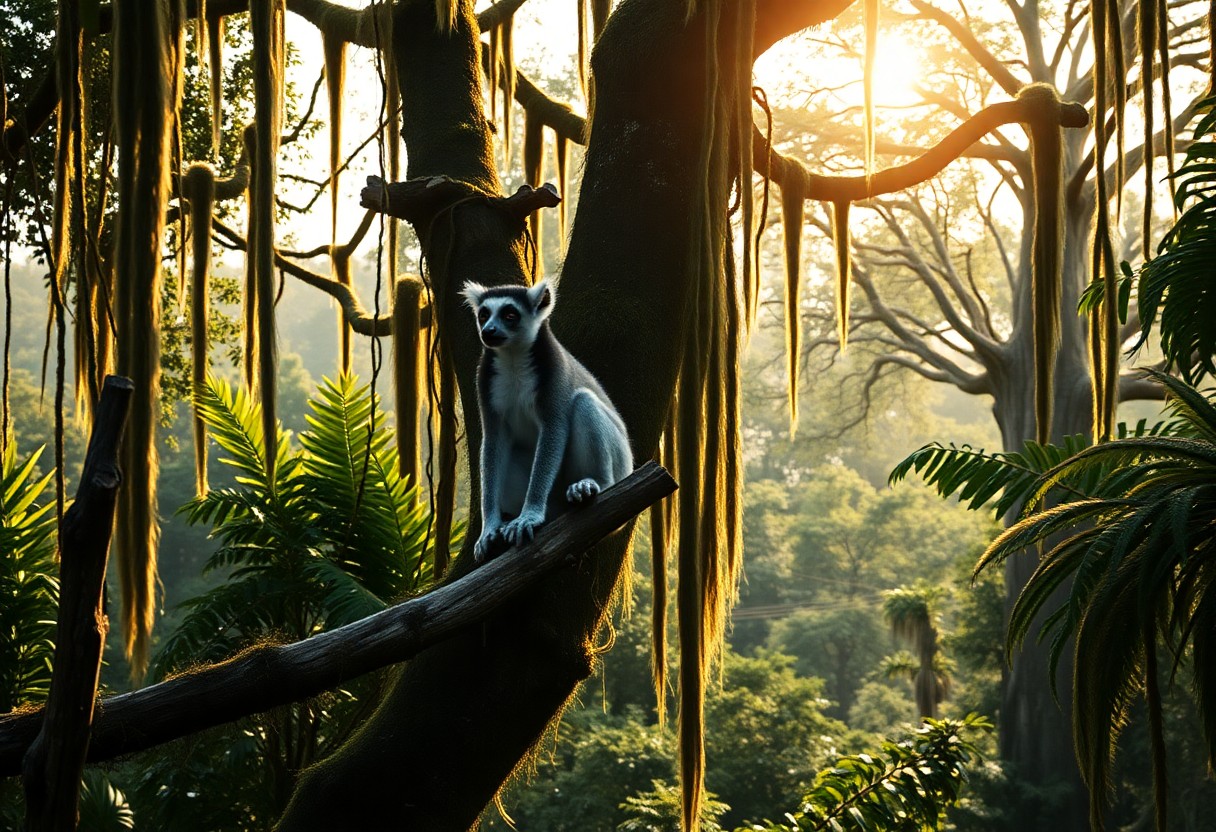
Just know you find lemurs only in Madagascar, where rampant habitat loss threatens many species, but protected forests help some populations survive.
Geographical Distribution: The Island of Madagascar
Madagascar is the only place in the wild where you can find all native lemur species, with nearly 100 species and subspecies confined to the island. You should know that widespread deforestation and habitat fragmentation are the island’s most dangerous threats to lemur survival.
Unique Biodiversity of the Malagasy Rainforests
Inside the rainforests you encounter a staggering level of endemism; you observe lemurs adapted to niches found nowhere else, from canopy acrobats to ground-dwellers. You will also see conservation successes in protected parks, though ongoing habitat loss still threatens many populations.
Microclimates and Regional Habitats
Rainfall patterns create distinct habitats, so you see rainforests in the east, dry deciduous forests in the west, and spiny thickets in the south, each supporting different lemur communities. You should plan conservation by region because microclimates produce unique species with limited ranges.
Coastal and highland variations mean you can encounter species restricted to tiny areas; you must understand that these range-restricted lemurs carry a high extinction risk, while expanding community-managed reserves offers a positive path forward.

Types of Lemur Habitats Across the Island
| High-Canopy Arboreal | Upper forest strata where sifakas and indri forage and sleep in trees |
| Mid-Canopy Riverine | Riparian corridors with fruiting trees that support seasonal movements |
| Spiny Forest | Drought-tolerant scrub hosting specialized feeders with thorny vegetation |
| Dry Deciduous Forest | Open, seasonal woodlands where some species show terrestrial adaptation |
| Montane Forest | Higher-elevation forests with cooler climates and restricted ranges |
- lemur habitats
- arboreal
- dry deciduous forests
- canopy
- terrestrial adaptation
High-Canopy Arboreal Environments
Canopies shelter many lemur species that you will see moving via leaping and brachiation; you rely on their strong grasping limbs and acute balance, with food resources concentrated in fruiting trees and raptor predation representing a persistent danger.
Terrestrial Adaptation in Dry Deciduous Forests
Dry forests host lemurs that spend more time on the ground, so you observe behaviors like sun-basking and ground foraging; these populations show adaptations for walking and increased vigilance because drought and habitat loss raise predation and scarcity risks.
Species expand home ranges and alter diets in the dry season, and you should note that fragmentation and hunting amplify threats while occasional fruit pulses create positive windows for reproduction and growth.
Assume that you will use these distinctions to prioritize canopy protection and dry-forest corridors in your fieldwork and conservation planning.
Factors Influencing Lemur Habitat Selection
You assess food, shelter, and predation when selecting where lemur groups settle, prioritizing seasonally abundant fruit and dense canopy for sleeping.
- Food availability
- Foraging ranges
- Shelter and roost sites
- Predation pressure
- Human disturbance
Perceiving threats and resource patches shapes movement and home-range decisions.
Dietary Availability and Foraging Ranges
Food distribution dictates how far you travel; patchy fruit forces longer foraging ranges, while continuous leaves keep home ranges smaller and concentrated.
Predator Avoidance and Shelter Security
Shelter selection reduces predation risk: you choose thick canopy, spiny plants, or high roosts to escape fossas and raptors; group size and alarm calls increase safety.
Canopy continuity allows quick escape routes; you use multiple roost sites and stacked branches to avoid ground predators and minimize exposure.
Where Do Lemurs Live
Step-by-Step Guide to Identifying Lemur Territories
| Step | Action / Tool |
|---|---|
| Reconnaissance | Local surveys, interviews, transects |
| Mapping | GIS, DEMs, NDVI vegetation layers |
| Monitoring | GPS collars, camera traps, acoustic sensors |
| Analysis | Seasonal overlays, home-range models, threat assessment |
Use layered mapping so you can delineate territory edges with confidence; combine GPS fixes, direct sightings, and nest site locations to define home-range boundaries and prioritize survey effort.
Observe disturbance signs and human activity to flag zones of high deforestation risk or predator hotspots, and update your territory maps after each field season to reflect real shifts.
Mapping Elevation and Vegetation Density
Map elevation contours and vegetation density together so you can spot preferred altitude bands and dense feeding patches; overlay NDVI to highlight dense canopy areas that support lemur foraging.
Assess slope and aspect because you must account for microclimate preferences; mark steep slopes and fragmented canopy that restrict movement or isolate populations.
Analyzing Seasonal Migration Patterns
Track seasonal movements with repeated transects or telemetry so you can identify corridors used during food shortages and breeding; label seasonal corridors for protection.
Consider rainfall and fruiting calendars to correlate movement timing, noting when groups expand into fruit-rich zones or contract to safer refuges near reliable water sources.
Compare multi-year movement data to reveal persistent shifts from habitat loss or climate change so you can target areas showing long-term decline for immediate conservation action.
Pros and Cons of Lemur Ecotourism
Ecotourism can channel funds and attention to protected areas; when you visit you help finance patrols and research, but you also risk increasing foot traffic and disturbance if you ignore rules. Strong visitor practices reduce harm while amplifying the positive economic effects for communities.
| Pros | Cons |
|---|---|
| Direct funding for parks and monitoring | Trampling and vegetation damage |
| Job creation for local guides and services | Disturbance of lemur behavior |
| Environmental education for visitors | Increased risk of pathogen transmission |
| Support for anti-poaching operations | Overcrowding at key sites |
| Incentives to conserve remaining forest | Habitat fragmentation from infrastructure |
| Research and monitoring opportunities | Local cultural disruption if unmanaged |
Benefits for Conservation and Local Economies
Community-run experiences convert your fees into patrols, education, and restoration projects, so your choices can deliver measurable conservation funding on the ground.
You directly support livelihoods by hiring guides and buying local services, which creates alternatives to logging and hunting and aligns local incentives with forest protection.
Risks of Habitat Disturbance and Pathogen Transmission
Visitors moving off trails or crowding can change lemur feeding and breeding patterns; you must follow distance and noise rules to limit behavioral disturbance.
Exposure to human-borne microbes is a serious threat: when you come sick or feed animals you raise the chance of pathogen transmission to vulnerable populations.
Close contact, feeding, or littering increases stress and disease risk; you should avoid direct interactions, comply with biosecurity measures, and report sick animals to guides to protect lemurs and yourself.
Tips for Responsible Lemur Observation
You should observe lemurs from a respectful distance, move slowly, avoid feeding, and keep noise to a minimum so you reduce stress and prevent disease transmission.
- Distance
- No feeding
- Quiet
Knowing you follow these conservation-focused practices helps protect individuals and supports long-term habitat recovery.
Essential Gear for Wildlife Tracking
Pack lightweight binoculars, a headlamp, durable boots, and a GPS or map so you can track movement without disturbing groups and ensure you record locations accurately.
Bring insect repellent, water, and a compact first-aid kit; you should avoid bright clothing and strong scents to reduce attraction or stress on animals.
Ethical Guidelines for Field Research
Follow local laws and research permits, obtain community consent, and ensure you minimize disturbance during sampling and observation to respect social structure and breeding seasons.
Obtain trained supervision for captures or handling; you should avoid anesthetizing without certification and keep safety as your priority.
Document methods, deposit data with local institutions, and share findings so you support community conservation and transparent science.
Summing up
On the whole you find lemurs only on Madagascar and a few nearby islands. The island’s rainforests, dry deciduous woods, spiny thickets and mountains host species adapted to canopy, understorey, or ground life, and habitat loss now threatens many populations, so your awareness and support aid conservation.