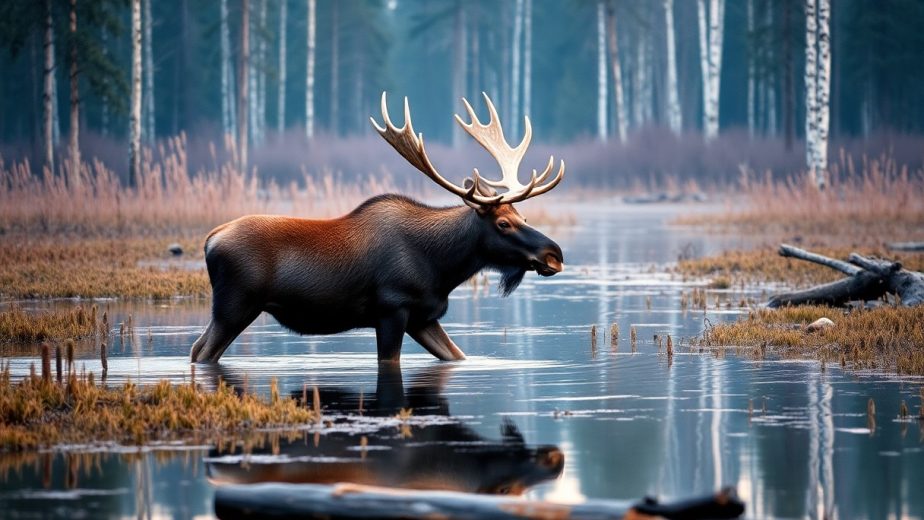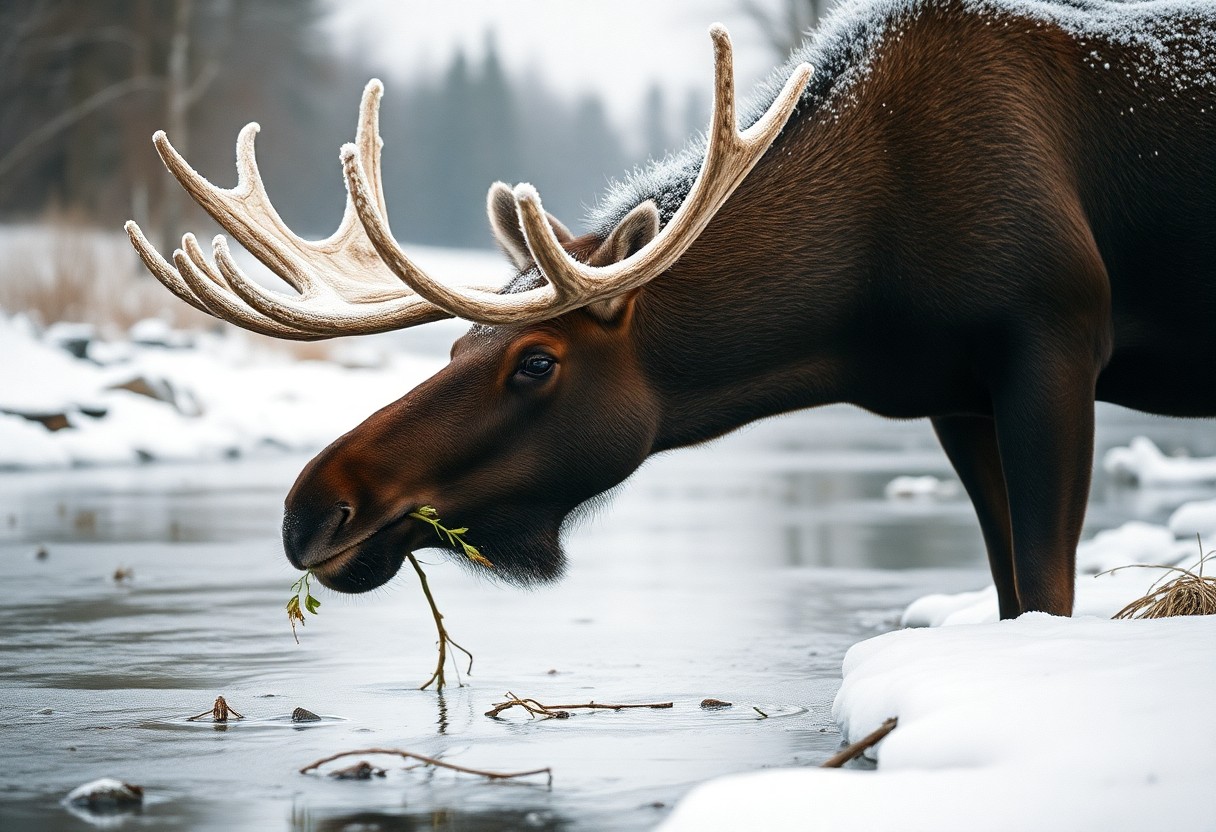
There’s little food in winter, and you should know moose eat woody browse (willow, birch), dig through snow to reach twigs, face starvation risk during deep snow, and rely on submerged aquatic plants and slow metabolism to survive.
Primary Types of Winter Forage
Winter forces moose to rely on a narrow set of foods, so you’ll see them targeting woody browse, stripped trunks and some evergreens when snow is deep. Browsing on deciduous twigs and buds delivers more protein, while coniferous needles remain available but are lower in digestible energy.
These categories vary by snow depth and stand composition, so you evaluate both access and nutritional payoff; the list and table below summarize what to watch for in winter forage assessments.
- Woody browse (willow, alder)
- Deciduous twigs (aspen, birch)
- Coniferous needles (spruce, fir)
- Bark stripping on stems and trunks
- Aquatic remnants in unfrozen wetlands
| Woody browse | High availability in browse zones; nutritious buds |
| Deciduous twigs | Tender late-winter shoots with higher protein |
| Coniferous needles | Present year-round but lower energy |
| Bark stripping | Provides calories yet can be harmful to trees |
| Aquatic remnants | Rich when accessible; limited by ice |
Woody Browse and Deciduous Twigs
You observe moose clipping willow and aspen twigs above the snowline because buds concentrate nutrients; those twigs are often the most positive winter resource for maintenance. Heavy use can suppress regrowth, so you weigh immediate gains against longer-term stand condition.
Coniferous Needles and Bark Stripping
Conifers supply needles as fallback feed and moose will strip bark when other forage is scarce, but you note that needles are lower quality and bark removal can escalate foraging time and tree stress. Visible bark stripping is a strong indicator of food limitation and ecological impact.
Perceiving fresh spiral strips and shredded cambium helps you assess severity: heavy bark stripping often precedes tree mortality and shows moose are relying on lower-quality conifer forage due to scarcity of better options.
Critical Factors Influencing Winter Diet
Winter accelerates shifts you observe in moose feeding: as forage quality declines you notice greater reliance on woody browse and body reserves, and factors like snow depth, vegetation height, and disturbance alter both access and energetic cost.
- Snow depth and crust
- Accessibility of vegetation (browse height, stem toughness)
- Metabolic shifts and caloric requirements
- Forage quality and patchiness
- Predation and human disturbance
Any assessment you make must weigh the energy spent reaching deep snow-buried browse against the caloric value of what the animal can actually consume.
Snow Depth and Accessibility of Vegetation
Deep snow depth reduces reach to low browse and forces you to map corridors to taller willows; you will see dangerous energy deficits where drifts exceed stride depth and block key feeding patches.
Metabolic Shifts and Caloric Requirements
Cold conditions raise the baseline you use to estimate daily needs: increased thermoregulation pushes up caloric requirements, so you track how much high-energy browse and fat stores remain.
You should consider that seasonal changes in digestion and fat mobilization mean a moose may catabolize lean tissue when intake falls, reducing future resilience.
Energy budgeting shows that moving through crusted snow can multiply costs, so you prioritize areas with accessible vegetation and concentrated browse to help maintain body condition.
Step-by-Step Guide to Identifying Moose Feeding Signs
Check for obvious signs: tall browse with torn ends around shoulder height, large cloven tracks, piles of coarse droppings, and rubbed saplings; you should map these features to focus inspections. Keep distance around winter yards because concentrated moose can be defensive.
Use a simple routine: note browse species (willow, birch), measure bite height, photograph tooth patterns, and record track spacing; you will build a reliable profile of moose activity after a few visits.
Key Moose Feeding Signs
| Sign | What to look for |
|---|---|
| Browse | Torn, ragged twig ends often >1.5 m high; willow and birch preferred |
| Tracks | Large cloven prints ~10-12 cm, often single-file through snow |
| Droppings | Dark, coarse pellets in piles near feeding spots |
| Rubs & Scrapes | Stripped bark and forehead rubs on saplings up to ~2 m |
| Bedding/Yards | Compacted snow, clustered tracks, concentrated browse areas |
Distinguishing Moose Browse from Other Ungulates
Compare browse height and cut pattern: moose feed high and leave ragged, torn ends, whereas deer and elk leave cleaner shears lower to the ground; you can separate species by height quickly.
Observe track and bite spacing: moose tracks are much wider with larger intervals between bites; you should measure prints and bite spacing to rule out smaller ungulates.
Locating Winter Yardal Areas and Tracks
Scan for clusters of trails radiating from a central bedding zone, areas of compacted snow, and concentrated browse; you must treat identified winter yards as sensitive and avoid disturbing them.
Follow distinct single-file tracks toward dense willow stands or sheltered conifer edges; you will notice deeper impressions where moose pause to feed, indicating feeding concentrations.
Mark likely yards on a map or GPS, noting track width, droppings, and nearby water; you will refine yard locations over multiple visits and use those markers to monitor seasonal shifts.
Pros and Cons of Common Winter Food Sources
Pros and Cons Summary
| Food Source | Pros / Cons |
|---|---|
| Willow | Pro: higher digestible energy and easily browsed; Con: limited height and can be locally overbrowsed. |
| Balsam fir | Pro: abundant year-round; Con: lower digestible nutrients and low caloric value. |
| Conifer needles (spruce, fir) | Pro: persistent availability; Con: tough, waxy, and poorly digestible. |
| Woody twigs / browse | Pro: accessible browse structure; Con: high fiber and low caloric density. |
| Submerged aquatic plants | Pro: nutrient-rich when accessible; Con: usually inaccessible under frozen water. |
| Bark | Pro: fallback during scarcity; Con: very low nutrition and abrasive to digest. |
| Lichens / moss | Pro: present on substrates; Con: generally low-quality for moose and limited benefit. |
| Salt/mineral sites | Pro: can attract moose and aid nutrition; Con: may concentrate animals and increase predation risk or disturbance. |
You weigh availability against caloric payoff when assessing winter forage, since persistent but low-calorie sources can sustain moose only if intake and travel costs remain favorable to you.
Habitat differences mean you often observe willow or aspen offering better energy per bite near riparian areas, while dense conifer stands give you quantity with much lower nutritional return.
Nutritional Density of Willow vs. Balsam Fir
Willow typically delivers more digestible carbohydrates and protein, so you classify it as a higher-density winter choice when it’s reachable and not heavily snow-covered.
Balsam fir supplies steadiness through winter but you note its lower digestible energy, requiring greater intake or longer foraging to match willow’s payoff.
Energy Expenditure of Foraging in Deep Snow
Deep snow increases locomotion costs and reduces bite-rate, so you should expect moose to favor accessible browse that minimizes excessive energy loss.
During extended heavy snowpack you observe animals concentrating near windblown areas or trails that offer reduced travel cost and safer feeding opportunities.
Snow depths above shoulder height often turn nutritious stands into net losses, so you must factor the extra effort required to reach those food patches when evaluating winter forage value.

Essential Tips for Observing Moose in Winter
- moose winter diet
- winter moose behavior
- safe wildlife viewing
Maintaining Safe Distances During Foraging
When you spot a moose feeding, keep at least 75-100 meters and use binoculars or a spotting scope to avoid disturbance. Stay downwind and quiet; signs like stomping, pinned ears, or raised hair signal agitation and require immediate retreat. You protect yourself and the animal by respecting space.
Ethical Photography in Sensitive Habitats
Avoid closing distance for a dramatic shot; rely on a telephoto lens and steady support so you do not interrupt feeding or force movement. Never bait or call moose, and disable flash near calves to prevent startling and abandonment.
Use low-impact techniques: shoot from concealed positions, limit session length, and prioritize images that show context rather than tight, intrusive close-ups. Protect young calves by never approaching and by moving away if adults show alert behavior.
Adjust your approach to minimize trampling of winter browse and fragile snow crusts; step back at the first sign of stress. Perceiving your actions as part of the scene helps you keep distance and ensure both you and the moose remain safe.
Summing up
Taking this into account, you should know that moose survive winter mainly by browsing woody vegetation-willows, birch, aspen, and conifer twigs and buds-and by consuming any available bark and needles when snow limits access to low forage. You can expect reduced feeding rates and reliance on fat reserves and strategic movement to conserve energy, so winter diet shifts toward high-fiber, low-energy woody browse rather than the aquatic plants moose eat in warmer months.