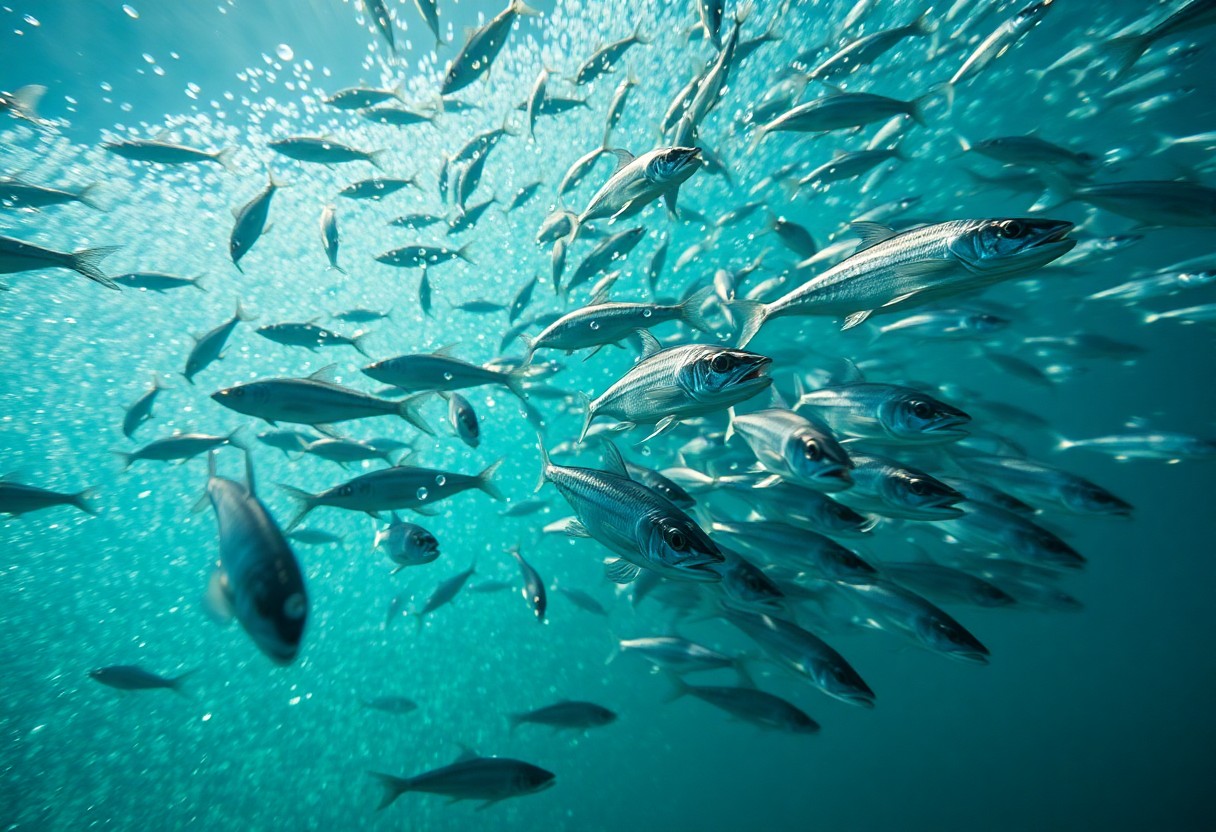
Most sardines feed on plankton; you should know they consume tiny phytoplankton and zooplankton, including copepods, forming a key link in marine food webs.
Primary Types of Plankton in the Sardine Diet
You observe that plankton form the bulk of sardine diets, supplying energy, protein, and vital fatty acids that drive schooling and migration.
Sardines concentrate where dense patches of phytoplankton and zooplankton appear, boosting their omega-3 stores but risking exposure to toxic blooms.
- Phytoplankton
- Diatoms
- Dinoflagellates
- Copepods
- Krill
| Diatoms | Silica-walled, highly productive and nutritious for sardines. |
| Dinoflagellates | Motile algae; some species cause toxic blooms that affect food safety. |
| Small flagellates | Abundant, easy to filter, important in poor-light feeding. |
| Copepods | Dominant zooplankton; rich in protein and attract dense feeding. |
| Krill | Larger crustaceans offering high energy per capture. |
Phytoplankton and microscopic algae
Microscopic phytoplankton supply carbohydrates and lipids you rely on to explain sardine condition; seasonal blooms can raise food density dramatically.
Zooplankton and small crustaceans
Tiny zooplankton such as copepods and amphipods deliver concentrated protein and fats that you watch for when assessing growth and survival.
After sardines gorge on dense zooplankton swarms, you note increased lipid stores that benefit predators and fisheries, though rapid shifts in plankton composition can sharply reduce food availability.
Environmental Factors Influencing Foraging Patterns
Currents and frontal zones concentrate prey, so you track them to find where sardines feed. You’ll notice shifting depth and timing as schools respond to moving patches and light.
- Water temperature
- Upwelling
- Prey patchiness
Schools change behavior around predators and productivity; you must weigh the risk of predator aggregations against the benefit of high prey density. Perceiving fine-scale cues helps you predict feeding events.
Water temperature and seasonal shifts
Surface temperature layers force sardines to track favorable thermoclines, so you follow seasonal shifts to anticipate feeding zones.
Temperature vs. Foraging
| Temperature change | Foraging response |
|---|---|
| Warming surface | Moves sardines deeper to cooler layers |
| Cooling season | Concentrates prey near surface, increasing feeding |
Nutrient-rich upwelling zones
Upwelling brings nutrients that trigger plankton blooms, so you expect sustained sardine feeding and large, visible schools near these zones; watch for increased predator presence as a danger.
Mixing intensity and wind-driven upwelling determine patch size, so you use satellite chlorophyll and local wind data to locate the richest feeding grounds and time your observations.
Pros and Cons of Sardine Feeding Mechanisms
You can weigh the trade-offs between filtration and selectivity: ram-filter feeding maximizes plankton intake with low energy per fish, while selective particulate feeding improves prey quality but raises vulnerability to patchy food and microplastic ingestion.
| Pros | Cons |
|---|---|
| High volumetric capture | Dependent on plankton density |
| Low individual energy cost | Reduced selectivity for nutritious prey |
| Effective in schools, amplifying intake | Increased predation risk while filtering |
| Captures wide plankton size range | Gill raker clogging in turbid waters |
| Simple anatomical requirements | Susceptible to seasonal and current shifts |
| Rapid exploitation of blooms | Higher ingestion of microplastics |
| Supports fast growth and reproduction | Local depletion and increased competition |
Efficiency of ram-filter feeding
Ram-filter feeding lets you see how sardines swim with open mouths to sweep vast volumes of water across gill rakers, producing very high filtration rates that exploit blooms efficiently and keep individual energy costs low.
Limitations of selective particulate feeding
Selective particulate feeding forces you to consider diet quality trade-offs: picking larger, energy-rich particles improves nutrition but leaves sardines exposed when prey is patchy and demands more maneuvering that raises predation risk.
Microplastics concentrate in the particulate fraction and can be ingested by sardines, creating a danger to fish health and a contamination pathway to you if affected fish enter the food chain.
Step-by-Step Breakdown of the Feeding Process
| Step | What you do |
|---|---|
| Detect | Use visual cues, olfaction and the lateral line to find dense plankton patches |
| Approach | School toward fronts or upwelling zones to concentrate effort and reduce predation risk |
| Filter | Open mouth and let gill rakers sieve zooplankton while water exits the gills |
| Ingest | Transfer trapped prey to the throat and swallow to convert intake into energy |
Locating high-density nutrient patches
You track temperature gradients, chlorophyll blooms and baitfish activity to pinpoint high-density nutrient patches that deliver maximum energy per effort while schooling reduces individual exposure.
Ocean features like fronts, eddies and upwelling concentrate phytoplankton and zooplankton, so you steer the school to exploit short-lived booms and maintain steady intake.
Mechanical filtration via gill rakers
Gill rakers act as a sieve: you swim with an open mouth so water flows through and zooplankton are trapped against raker surfaces while excess water exits the gill slits.
Filtration performance hinges on raker spacing and swimming speed, so you modulate velocity to match prey size and keep feeding efficient.
Rakers also limit ingestion of large debris but can clog from fine sediment or harmful algal aggregates, so you often change depth or direction to avoid such dangerous patches and preserve feeding success.
Expert Tips for Monitoring Sardine Feeding Cycles
Observe that sardines concentrate on dense patches of plankton-phytoplankton, copepods and small crustaceans-so you should target sampling where chlorophyll and currents converge to find feeding hotspots.
- Use hydroacoustic surveys to map schools.
- Deploy plankton nets to quantify prey abundance.
- Monitor chlorophyll via satellite for bloom-related aggregation.
Check tidal phase and light levels when scheduling observations, because feeding cycles often peak at dusk and dawn and hypoxia can force sardines to change depth quickly.
Identifying peak feeding hours
Night sampling reveals surface feeding during low light, so you should focus on twilight windows when zooplankton migrate upward and feeding intensifies.
Morning echo-sounder transects paired with net tows let you pinpoint hour-by-hour changes and confirm peak feeding hours around sunrise in many systems.
Using environmental indicators for tracking
Watch sea-surface temperature and satellite chlorophyll anomalies to predict where sardines will aggregate around rich food patches.
Measure dissolved oxygen and thermocline depth because low oxygen zones and sharp stratification can either concentrate prey or create avoidance zones-monitor for hypoxia events.
Any integrated program combining remote sensing, in situ sensors and acoustic surveys improves your ability to anticipate shifts; prioritize real-time data feeds and flag dangerous hypoxia quickly.
Ecological Impact of Sardine Nutrient Consumption
Sardines shuttle nutrients from plankton to higher trophic levels, so you see shifts in productivity when their numbers change. Their feeding and excretion accelerate nutrient cycling and support both local fisheries and ocean resilience. Protecting sardine populations safeguards this nutrient conduit and reduces the risk of broad ecosystem imbalance.
Energy transfer to marine apex predators
Their dense schools provide you with a concentrated source of calories for tuna, sharks and seabirds; predator populations and fishery yields track sardine abundance closely. When sardine biomass collapses you observe cascading declines, and when abundant they enable predator reproduction and growth. Overfishing can remove that dense food supply rapidly.
Maintaining balance in the pelagic food web
Healthy sardine grazing keeps phytoplankton composition stable, so you avoid sudden algal spikes that harm water quality and fisheries. Through selective feeding and excretion sardines help recycle nutrients into forms that favor productive, open-ocean ecosystems; their loss shifts food webs toward less desirable species and greater variability.
Overfishing of sardines forces you to adapt management as nutrient flows and plankton communities change. Reduced sardine numbers can favor jellyfish and small opportunistic pelagics, increasing unpredictability; rebuilding sardine stocks restores stable nutrient pathways and more reliable fisheries.
Summing up
From above, you see that sardines feed mainly on plankton, especially copepods, krill, and phytoplankton during juvenile stages. Small-mesh gill rakers and filter-feeding enable you to link their schooling behavior to feeding in nutrient-rich upwellings and coastal waters. Seasonal and regional changes alter prey composition, which you factor in when assessing their role as forage fish and their value to fisheries and predators.